


For parents of tweens and teens
Back-to-School Checklist
a new school year, a fresh start
A new school year is one of the only clean slates a family gets.
Everybody walks in a little older, a little more capable, and a little more willing to try something different. That window doesn’t stay open long. What you do with the two weeks before the first bell shapes a lot of what comes after it.
This free checklist gives you a way to use that window on purpose. Twelve moves across four layers, starting with your own nervous system and ending with what to actually say when it gets hard.
Fill out the form at the bottom of this page and it’s yours.
Why this one is different
Most back-to-school advice hands you a routine chart and a bedtime and calls it a day.
Routines matter. I have a whole section on them in here. But if you’ve parented a teenager, you already know what happens to a routine you built without them: it lasts about nine days, and then you’re the enforcer again, nagging about a chart nobody agreed to.
The reason those systems fall apart has almost nothing to do with the system. It has to do with everything around it. How regulated you were when you brought it up. Whether your kid felt like a partner or a project. Whether the two of you had any connection in the tank before you started negotiating screen limits.
That’s the whole idea behind this checklist. It’s built on the intentional ecosystem, the framework I use with every parent I work with, and it moves through four nested layers from the outside in.
The four layers
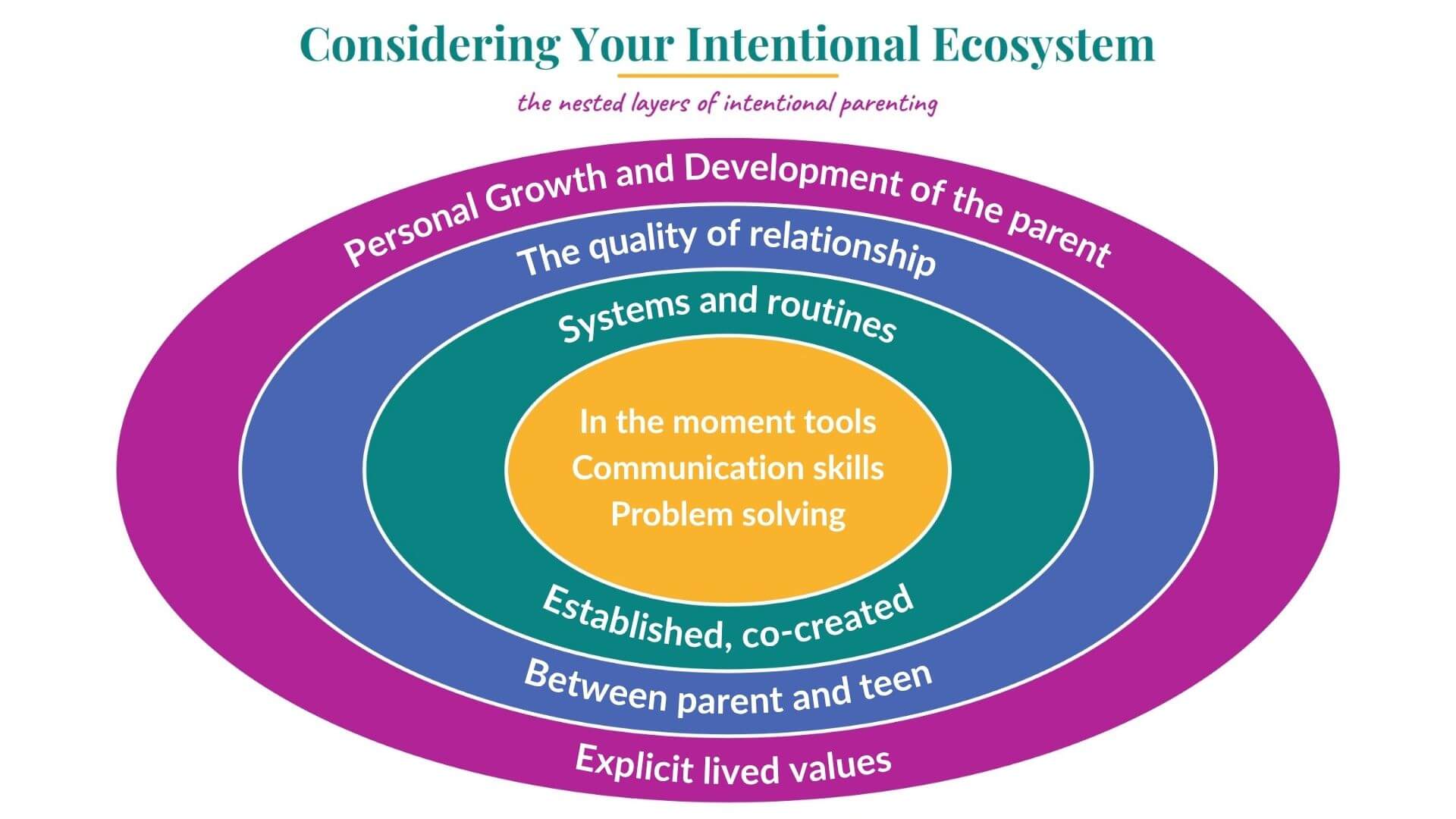
Layer one
Personal growth and development of the parent
Your regulation, your mindset, your explicit lived values. This is the outermost layer, and everything else grows in the conditions it creates. You’ll start here, before you say a word to your kid.
Layer two
The quality of relationship
Connection before correction, every time. A kid who feels close to you will let you into the harder conversations. A kid who doesn’t won’t, no matter how good your opening line is.
Layer three
Systems and routines
Established and co-created. This is where the bedtimes and the screen limits and the “text me when you’re leaving” live. Built together, they hold. Built alone, they’re rules you’ll spend the year enforcing.
Layer four
In the moment tools
Communication skills and problem solving. What you actually say when your kid is frustrated and you’re tired and the moment is right in front of you.
tend them from the outside in
Most of us go looking for that last layer first. We want the perfect thing to say. What I’ve learned in almost twenty years of doing this work is that the perfect thing to say lands completely differently depending on how tended the outer layers are.
What you’ll walk away with
A conversation your teen doesn’t dread
You’ll know how to open it, when to open it, and what to own up front so they don’t come in braced for a lecture.
Agreements instead of rules
There’s a real difference, and your October self will feel it. Agreements are something you return to together. Rules are something you enforce alone.
A clear read on what’s yours and what’s theirs
You can’t control your child’s academic experience. You have more influence than you think over how they feel about what’s possible for them. The checklist helps you sort one from the other and put your energy where it actually goes somewhere.
Language that keeps the door open
Specific phrases for the moments when curiosity is hard and judgment is easy.
A plan for circling back
This isn’t a one-and-done conversation. You’ll leave with a rhythm for checking in, so the first hard week of the semester doesn’t undo everything you set up in August.
Permission to let some of it be hard
Failed tests, missed assignments, uncomfortable conversations with teachers. All of it is fertile ground for the life skills our kids are actually in school to build. Your work is to keep tending the ecosystem while they do the growing.
What’s inside
Eight pages, designed to be printed and written on.
- A letter from me about how to use it and what to expect
- The full intentional ecosystem framework, laid out visually
- Twelve checklist items across the four layers, each with the reflection or conversation that goes with it
- Space on every page for your own notes
- A rhythm for coming back to it through the fall
Free. Yours to keep. Print it, mark it up, and pull it out again in October when everyone’s tired.
Who made this
I’m Casey O’Roarty. I’m a Positive Discipline Lead Trainer, the host of the Joyful Courage Podcast, and the Adolescent Lead here at Sproutable. I’ve spent nearly twenty years working with parents of tweens and teens, and I wrote Joyful Courage: Calming the Drama and Taking Control of YOUR Parenting Journey.
I made this guide because I needed it. What’s in this checklist is what I practiced with my own two every time a new school year came around. They’re grown now, and the years I spent tending these layers are the reason we still talk the way we do.
I believe in you, and I believe in your child.
Fiercely committed, lovingly detached,Casey
Get the Back-to-School Checklist
Fill out the form below and it’ll be in your inbox in a minute. Print it, grab a pen, and start with the first item before your kid gets home.
*By filling out the form below you are agreeing to join the Sproutable newsletter. Unsubscribe at any time.
Looking for something different?
Coaching
Private coaching with
our Adolescent & Early Years Lead
Free Workshop
Free workshops for parents/caregivers of infants to teens.
Audio summits
Exclusive podcast interviews with parenting experts. Lifetime access.